How Many Tie-Down Straps Do You Actually Need?
09/23/26
When you're securing cargo, one of the most common questions is: How many tie-down straps do I need?
There's no single number that works for every load.
The right number depends on what you're hauling, how much it weighs, how it could move during transport, where your anchor points are located, and the securement requirements that apply to your specific vehicle and cargo.
A lightweight piece of outdoor equipment may need a very different securement setup than a heavy appliance, motorcycle, ATV, or piece of construction equipment.
The goal isn't simply to use more straps. It's to use enough appropriately rated tie-downs, positioned correctly, to control the load in every direction.
The Short Answer: It Depends on the Load
Before choosing your straps, consider six questions:
- What are you securing?
- How much does it weigh?
- Can it shift forward, backward, or sideways?
- How will you transport it?
- How many suitable anchor points are available?
- What securement requirements apply to the load and vehicle?
These factors work together to determine how many tie-downs you need.
For regulated commercial transportation, applicable federal, state, or local cargo-securement requirements may specify minimum numbers, placement, Working Load Limits, and other requirements. Always follow those requirements as well as the instructions provided with your vehicle, trailer, cargo, and tie-down equipment. These requirements can often be found on the WSTDA, FMCSA, DOT, or other respective governing bodies' websites.
For everyday consumer hauling, the same basic principle applies: secure the load so it cannot shift, tip, roll, or become detached during transportation.
Why Do You Need More Than One Strap?
Using multiple tie-downs isn't only about increasing total strength.
It's also about controlling movement.
A single strap may hold a load down, but it may not adequately prevent the load from moving:
- Forward during hard braking
- Backward during acceleration
- Side-to-side while turning
- Upward from bumps or wind
- In multiple directions when the load is tall or unstable
Multiple properly positioned tie-downs can distribute the securement forces and control movement from different directions.
Think about a piece of furniture in the back of a pickup. One strap across the middle may help hold it down, but additional securement points can help prevent the furniture from sliding or tipping toward the front, rear, or sides.
Start With the Load
The first step is understanding what you're actually securing.
Small, Lightweight Items
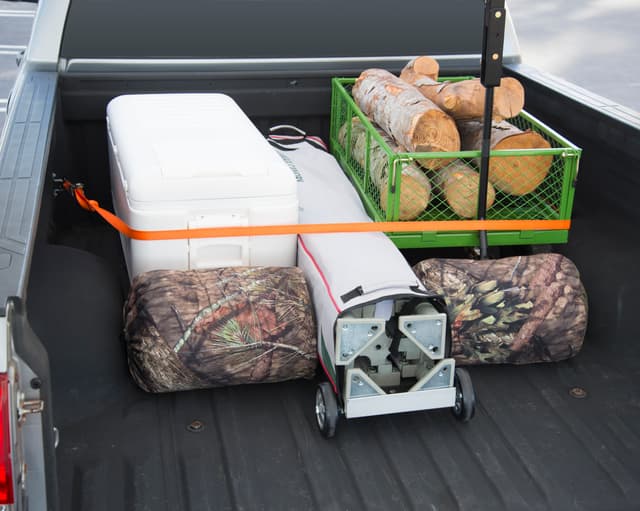
Common examples include:
- Coolers
- Camping equipment
- Lawn tools
- Small boxes
- Outdoor gear
These may require fewer or lighter-duty tie-downs, depending on the item and how it is transported.
However, "lightweight" doesn't mean "doesn't need to be secured." Even relatively light objects can move when a vehicle brakes suddenly or makes a sharp turn.
Large or Heavy Items
Examples include:
- Appliances
- Furniture
- Riding lawn mowers
- Motorcycles
- ATVs and UTVs
- Construction equipment
These loads generally require more careful planning because their weight and mass can generate significant forces during transportation.
Heavier or taller loads may also require multiple securement points to control movement and prevent tipping.
Weight Matters—but Don't Just Look at Strap Break Strength
When determining whether a tie-down is appropriate, use its Working Load Limit (WLL) rather than simply looking at the largest number printed on the package or website.
Break strength describes the force at which a strap may fail under laboratory testing. Working Load Limit is the maximum load the product is designed to handle during normal use.
When multiple tie-downs are used, their ratings don't automatically mean you can simply add the WLLs together and assume the resulting number represents your total securement capacity.
The actual capacity of a securement system depends on factors such as:
- How the straps are positioned
- The direction of the securement forces
- Anchor-point strength
- Attachment hardware
- Tie-down angles
- The condition of the equipment
- The way the cargo is loaded
The weakest component or connection can limit the overall system.
Think About Movement in Every Direction
One of the easiest ways to determine whether your load is adequately secured is to think about what could happen if the vehicle suddenly accelerates, brakes, or turns.
Forward Movement
Ask:
"What will keep this load from sliding toward the front of the vehicle?"
This is particularly important for heavy objects in truck beds and trailers.
Backward Movement
Ask:
"What will keep the load from moving toward the rear?"
This can become a concern during acceleration or on an incline.
Side-to-Side Movement
Ask:
"What prevents this load from shifting when I turn?"
Side-to-side movement can be especially problematic with tall, narrow, or unstable cargo.
Upward Movement
Ask:
"Could the load bounce, lift, or become partially airborne?"
A properly tensioned tie-down can help keep cargo seated, but the securement method needs to be appropriate for the load and transportation system.
Use Anchor Points That Match the Job
A tie-down is only as effective as the anchor point it's attached to.
Use designated or manufacturer-approved anchor points whenever possible.
Depending on the vehicle or trailer, these might include:
- Truck-bed tie-down loops
- Trailer D-rings
- E-track systems
- Trailer rails
- Cargo rings
- Roof-rack attachment points
Don't attach a strap to a bumper, trim piece, suspension component, or other location that isn't designed for cargo securement.
Before every haul, inspect your anchor points for damage, excessive wear, corrosion, or anything else that could compromise the connection.
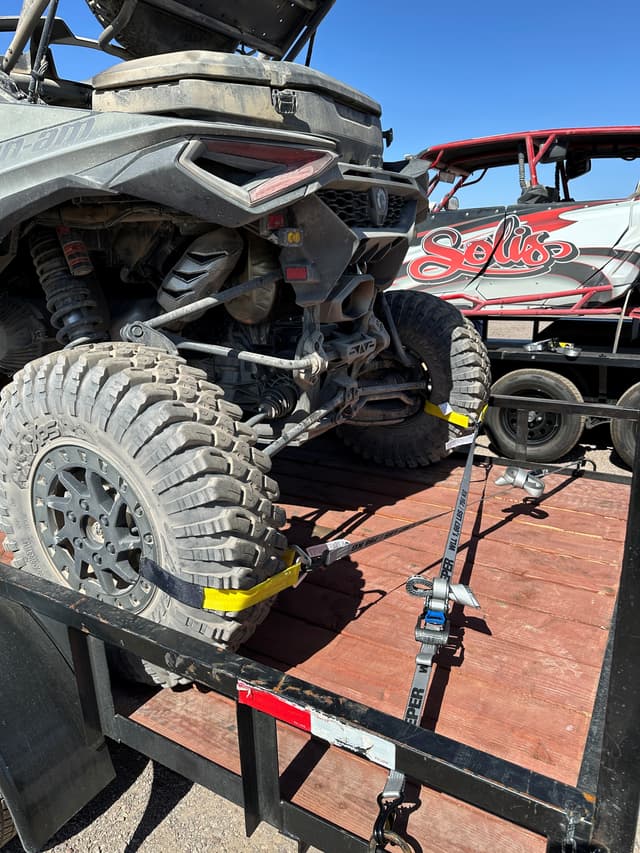
A Simple Example: Securing an ATV
Imagine you're transporting an ATV on a utility trailer.
Instead of asking:
"How many straps do I need?"
Start by asking:
"How will I prevent the ATV from moving in every direction?"
You might use appropriately rated tie-downs at multiple securement points so the ATV is held firmly against the trailer and movement is controlled toward the front, rear, and sides.
The exact number and placement should be based on the ATV and trailer manufacturer's instructions, the tie-downs' ratings, the available anchor points, and applicable cargo-securement requirements.
The important lesson is that the number of straps is determined by the cargo being secured—not by a universal rule such as "two straps for everything."
Transportation Method Changes the Answer
The same piece of equipment may require a different securement approach depending on how you're transporting it.
Pickup Truck
Consider:
- Available bed anchor points
- Cargo size
- Whether the load can shift or roll
- Whether the load extends beyond the bed
- Whether additional stabilization is necessary
Utility Trailer
Consider:
- Trailer anchor-point locations
- Cargo weight and dimensions
- Whether the load can roll or tip
- Whether straps can be positioned to control movement in multiple directions
Roof Rack
For kayaks, paddleboards, bikes, and similar recreational equipment, the rack and carrier become part of the securement system.
The number and placement of straps should follow the rack, carrier, and equipment manufacturer's instructions.
Enclosed Trailer
With fewer opportunities to use side anchor points, you may need to plan your strap placement differently. E-track and other dedicated cargo systems can provide additional attachment options.
Don't Assume More Straps Always Means More Secure
It may seem logical that adding more straps automatically makes a load safer.
Not necessarily.
Extra straps can help when they provide meaningful additional securement, but straps should be positioned correctly and connected to suitable anchor points.
Adding straps improperly can:
- Create awkward loading angles
- Put unnecessary stress on cargo
- Cause straps to interfere with one another
- Make inspection more difficult
- Give a false sense of security
The goal is controlled, balanced securement—not simply the maximum number of straps.
Choose the Right Type of Tie-Down
The number of straps is only part of the decision. You also need the right type of tie-down for the application.
Ratchet Straps
Ratchet straps provide mechanical advantage that makes it easier to apply tension.
They're often useful for:
| Cargo | Recommended Keeper Product |
|---|---|
| Heavy equipment | 2" x 27' Heavy-Duty Ratchet Strap Tie-Down, 04622 |
| ATVs and UTVs | 1.5" x 16' ExtremeEdge® Ratchet Tie-Down, 1667lbs. WLL, 43579 |
| Motorcycles | 1" x 8' High Tension Ratchet Tie-Down, 45721 |
| Appliances | 1"X12' Extreme Edge Ratchet Tie-Down, 500 lbs WLL, 43576 |
| Large or bulky cargo | 1-3/4" x 15' High Tension Ratchet Tie-Down, 05521 |
Cam Buckle Straps
Cam buckle straps allow you to tighten the webbing by hand without the mechanical advantage of a ratchet.
They're often a good choice for:
| Cargo | Recommended Keeper Product |
|---|---|
| Kayaks | 1" x16' Camo Cam Buckle Tie-Down, 47100 |
| Paddleboards | 1" x 6' Cam Buckle Tie-Down, 05108-V |
| Camping equipment | 1" x 6' Cam Buckle Tie-Down, 89715 |
| Lighter recreational gear | 1-1/4" x 8' Cam Buckle Tie-Down, 47110 |
| Cargo that could be damaged by excessive tension | 2" x 10' Cam Buckle Tie-Down with S hooks, 47309 |
Retractable Tie-Downs
Retractable designs are convenient for frequently used anchor points where quick setup and easy storage are priorities. Keeper recommends this retractable tie-down: Retractable Ratchet Tie-Down, 1"x10', 43557
Regardless of strap type, always select a product with a Working Load Limit appropriate for the application.
Check Your Securement Before You Drive
Once you've attached your tie-downs, don't immediately hit the road.
Walk around the load and check:
- Every hook is fully seated.
- Straps are properly positioned.
- Webbing is flat and free of twists.
- Tie-downs are appropriately tensioned.
- Cargo isn't shifting or leaning.
- Anchor points are secure.
- Loose strap ends are contained.
- No strap is rubbing against a sharp edge without appropriate protection.
For longer trips, stop after the first few miles and recheck the load. Continue checking periodically throughout the trip.
So, How Many Tie-Down Straps Do You Need?
There is no universal number of tie-down straps that is correct for every load.
The right number depends on:
Load + Weight + Movement Risk + Anchor Points + Transportation Method + Applicable Securement Requirements
Start by understanding the load and how it could move. Then select appropriately rated tie-downs and position them so they control movement in the directions that matter.
For regulated cargo, follow all applicable cargo-securement requirements. For consumer hauling, follow the instructions provided by the vehicle, trailer, cargo, and tie-down manufacturers.
And remember: more straps aren't necessarily better if they're not being used correctly. The right number of properly rated, properly positioned tie-downs is what matters.
At Keeper, we're here to help you choose the right way to secure the gear you care about—so you can spend less time worrying about your load and more time getting where you're going.